Whispers of Eternity: A Journey Through Varanasi
December 24, 2025
Whispers of Eternity: A Journey Through Varanasi
Prologue: Where Time Learns to Pause
There are cities you visit, and then there are cities that visit you—settling quietly into your thoughts, lingering long after you have left. Varanasi belongs to the latter. Often described as the oldest living city in the world, it is not merely a destination on the map of India; it is a state of being. Here, time does not march forward in neat, linear steps. Instead, it circles, folds, and dissolves, whispering secrets of eternity into the ears of those who are willing to listen.
From the moment one steps onto its ancient soil, Varanasi announces itself not with grandeur, but with depth. The air feels heavier, saturated with incense smoke, river mist, and centuries of human longing. Bells ring from unseen temples, mantras float across narrow lanes, and the sacred Ganga flows on—patient, eternal, indifferent to the rise and fall of empires. This is a city where life and death walk hand in hand, unafraid, unashamed.
The Mythic Beginning: Born of Light and Legend
Varanasi’s story begins not in history books, but in myth. According to ancient Hindu texts, the city was founded by Lord Shiva himself, making it one of the most sacred places in Hindu cosmology. It is believed that Varanasi stands on the trident of Shiva, protected from destruction even during cosmic dissolution. Whether one views this as faith or metaphor, the sense of permanence here is undeniable.
For thousands of years, sages, seekers, scholars, and pilgrims have traveled to this city in search of something ineffable—moksha, truth, peace, or simply understanding. Varanasi has been mentioned in the Rigveda, the Upanishads, the Puranas, and countless other texts. Each reference adds another layer to its identity, reinforcing its role as a spiritual axis around which Indian civilization has long revolved.
Yet, Varanasi is not frozen in its mythic past. It breathes, adapts, and evolves, carrying its legends lightly even as it embraces the chaos of modern life.
First Light on the Ghats: Dawn Along the Ganga
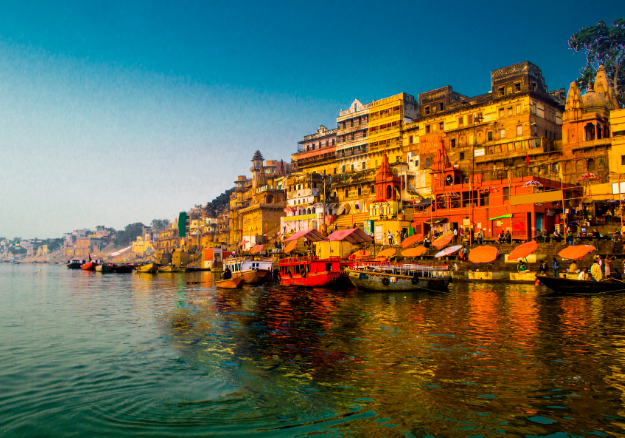
To witness Varanasi at dawn is to understand why poets struggle for words. As the first hints of sunlight spill across the horizon, the ghats—those iconic stone steps leading down to the river—come alive in a choreography as old as memory. Pilgrims descend quietly, their footsteps echoing against ancient stone. Some carry brass vessels, others flowers, all carrying faith.
The Ganga at dawn is a mirror of the sky, reflecting soft hues of pink, gold, and blue. Boats glide gently across the water, their oars breaking the surface with rhythmic grace. Priests chant Vedic hymns, their voices low and resonant, blending with the splash of water and the flutter of birds waking to the day.
Bathing in the river is not merely a ritual here; it is an act of surrender. Devotees believe that the Ganga washes away sins accumulated over lifetimes. Whether one shares this belief or not, there is an undeniable sense of renewal in watching people immerse themselves in the river, eyes closed, palms joined, whispering prayers that rise like mist into the morning air.
The Ghats of Life and Death
Varanasi’s ghats are not uniform; each has its own identity, purpose, and story. Dashashwamedh Ghat is the most vibrant, pulsing with energy throughout the day. Assi Ghat offers a quieter, more contemplative atmosphere, favored by students, artists, and long-term travelers. Panchganga Ghat carries historical weight, believed to be the confluence of five sacred rivers.
And then there are the cremation ghats—Manikarnika and Harishchandra—where the city’s philosophy reveals itself most starkly. Here, death is not hidden behind walls or euphemisms. Funeral pyres burn continuously, day and night, flames licking the sky as bodies are reduced to ash.
To many visitors, this sight is unsettling at first. But spend time here, and a strange calm settles in. Death in Varanasi is not an end; it is a transition. Families mourn, yes, but there is also acceptance. It is believed that to die in Varanasi is to be liberated from the cycle of rebirth. In this belief, grief and hope coexist, just as life and death do on these steps.
Labyrinths of the Soul: The Old City Lanes
Away from the river, Varanasi unfolds as a labyrinth of narrow गलियाँ (lanes), where getting lost is not a problem but a privilege. These winding pathways have witnessed centuries of footsteps—traders, saints, invaders, poets. Buildings lean into each other like old friends sharing secrets, their walls adorned with faded murals, political posters, and sacred symbols.
Cows wander freely, unbothered by traffic or time. Cycle rickshaws squeeze through spaces that seem impossibly narrow. Shopkeepers call out cheerfully, offering silk sarees, brass idols, rudraksha beads, and sweet paan wrapped in betel leaves.
Every turn reveals something unexpected: a tiny shrine glowing with oil lamps, a classical music rehearsal echoing from an upstairs room, a group of children playing cricket with infectious joy. These lanes are not just physical pathways; they are corridors into the soul of the city.
The Sound of Eternity: Music, Mantra, and Silence
Varanasi is a city of sound. Temple bells ring with hypnotic regularity. Conch shells announce ritual beginnings. Street vendors chant their wares in melodic patterns passed down through generations. Above all, there is music—deeply rooted, profoundly spiritual.
The city is a cradle of Indian classical music, home to legendary musicians and the revered Banaras Gharana. Even today, one can stumble upon an impromptu concert in a temple courtyard or hear a raga drifting through the night air. Music here is not performance; it is prayer.
Yet, amid all this sound, Varanasi also offers silence—not the absence of noise, but a presence of stillness. It can be found in early morning meditation by the river, in the focused gaze of a sadhu, or in the quiet acceptance of those waiting by the cremation fires. This silence speaks volumes.
Epilogue: Carrying Varanasi Within
Leaving Varanasi is not easy. The city clings to you, not through souvenirs or photographs, but through altered perspectives. It teaches acceptance without resignation, devotion without dogma, and depth without solemnity.
In the end, Varanasi is less about the place and more about the experience of being fully present. Its whispers of eternity continue long after the journey ends, echoing softly within, reminding us that time is fleeting, life is sacred, and some cities are not meant to be understood—only felt.